Fastener Finishes: Zinc, Black Oxide, Nickel and Zinc Flake
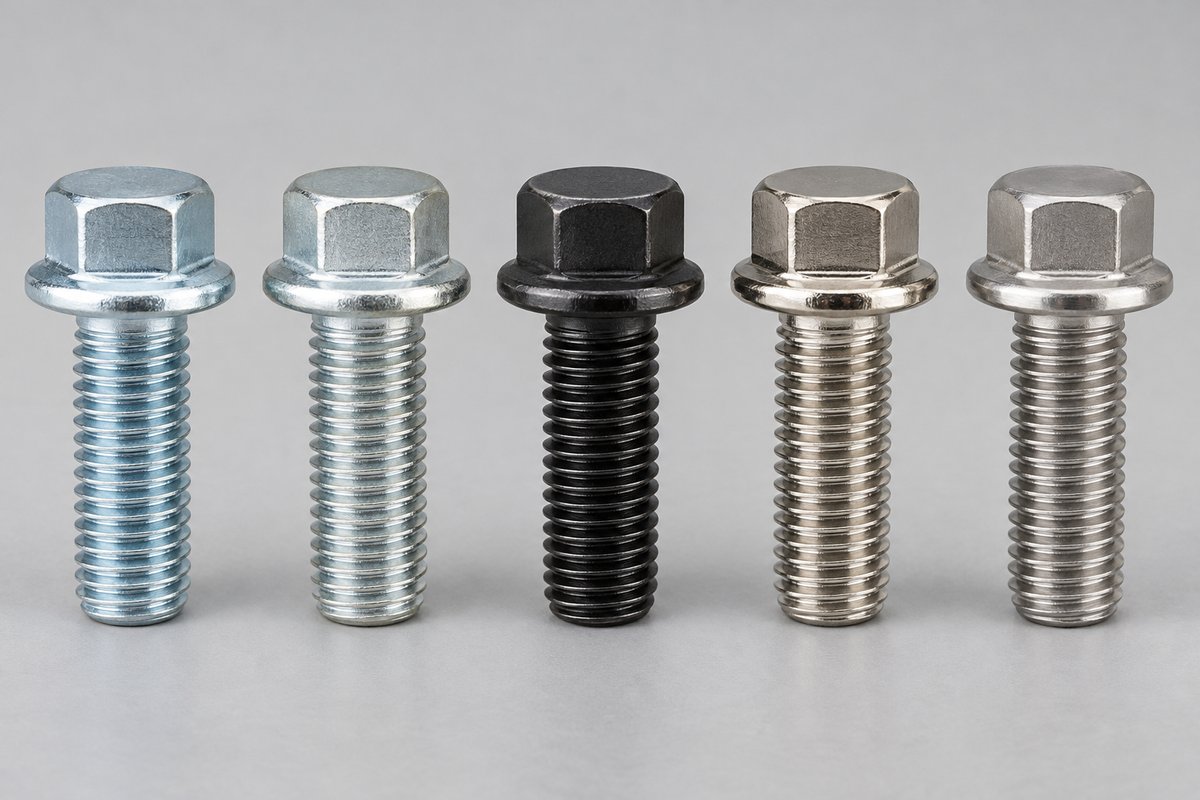
The finish on a fastener sets its corrosion resistance, appearance and sometimes its friction during tightening. Zinc plating with trivalent passivation has replaced hexavalent chromate in most markets because of RoHS and similar restrictions.
Common fastener finishes
| Finish | Characteristics | Typical uses |
|---|---|---|
| Zinc plating + trivalent passivation | General corrosion protection; clear/blue or black | General machinery and electrical |
| Black oxide | Very thin, little dimensional change; low corrosion resistance, supplemented with oil | Machine parts, socket head cap screws |
| Nickel plating | Appearance and corrosion resistance | Electronics, visible parts |
| Zinc flake | Non-electrolytic, lowers hydrogen embrittlement risk; high corrosion resistance | Automotive, high-strength bolts |
| Passivation | Restores the passive layer on stainless steel | Stainless fasteners |
| Anodizing | Colors and oxide layers on titanium and aluminum | Titanium bolts, aluminum screws |
Corrosion requirements are usually specified as hours to white or red rust in neutral salt spray testing (ISO 9227 / ASTM B117).
Notes when choosing
- Coating thickness and thread fit — plating adds thickness to the thread, so pre-plate thread tolerances must allow for it.
- High-strength bolts and hydrogen embrittlement — for class 10.9 and above, specify baking after electroplating or choose zinc flake.
- Color consistency — passivation color can vary with process conditions; agree a limit sample if appearance matters.
FAQ
Is trivalent zinc plating RoHS compliant?
Trivalent passivation does not use hexavalent chromium and is widely used for RoHS compliance. Ask for RoHS test data at the quotation stage if you need it.
Black oxide or black zinc?
Black oxide is a very thin conversion layer with almost no dimensional change but limited corrosion protection. Black zinc (zinc plating with black passivation) protects much better but adds coating thickness to the thread.